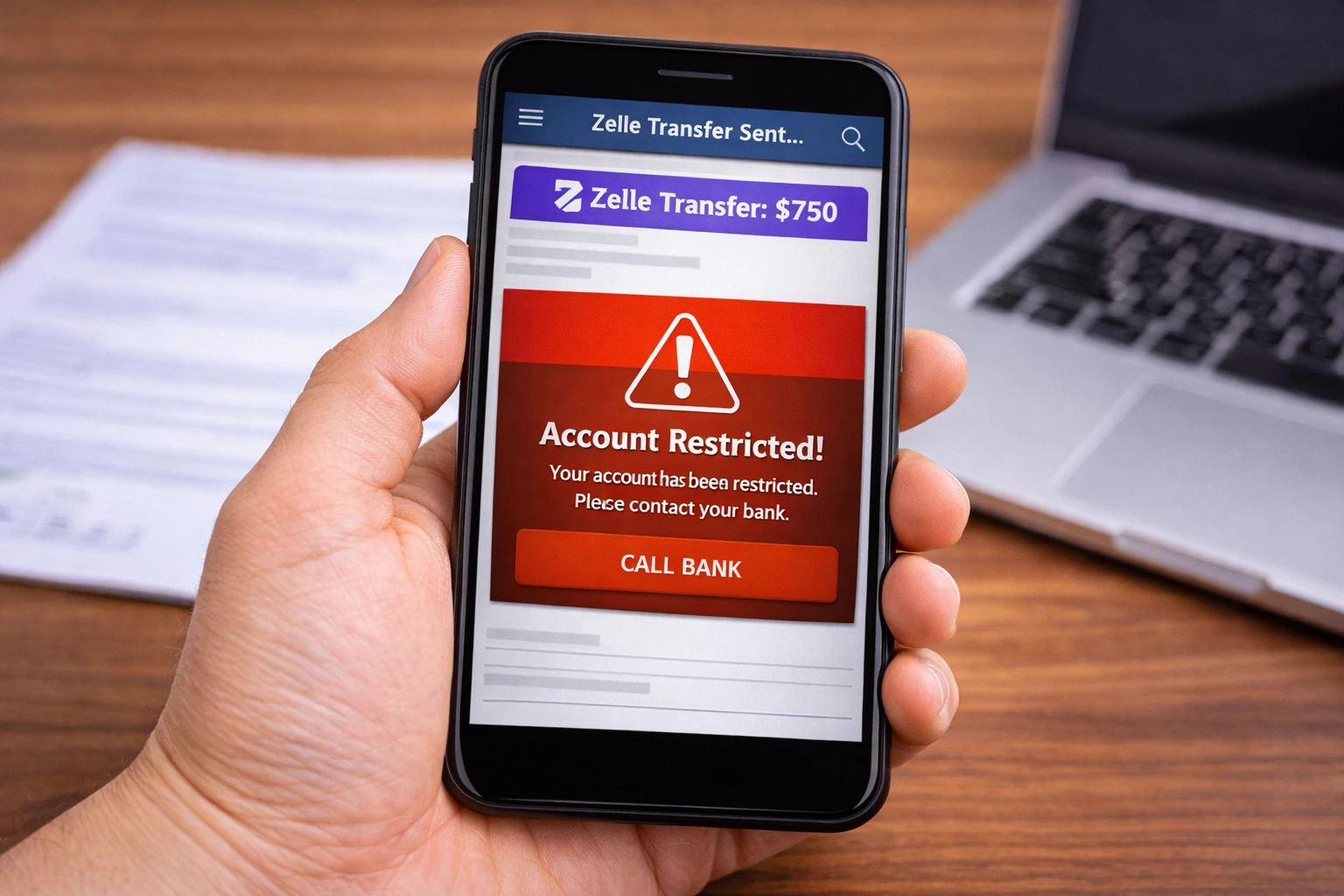
Quick answer: If your bank account was restricted after a Zelle payment, the transfer triggered an automated fraud or security review. Zelle is monitored at a lower flagging threshold than traditional bank transfers because payments are instant and essentially irreversible — making Zelle activity one of the most common restriction triggers at major banks. Most Zelle-related restrictions resolve within one to three business days once the bank verifies the payment was authorized and legitimate.
Estimated reading time: 10 minutes
This guide explains exactly why Zelle triggers bank account restrictions, how Zelle monitoring works at both the bank and network level, the difference between sending-triggered and receiving-triggered restrictions, what happens to the Zelle payment itself during the review, and what steps resolve the restriction fastest.
Why Zelle triggers restrictions more easily than other payment methods
Zelle is not just a payment app — it is a network operated by Early Warning Services (EWS), a company jointly owned by seven major U.S. banks including Bank of America, Chase, Wells Fargo, and U.S. Bank. When you send or receive money through Zelle, the transaction is monitored at two levels simultaneously: by your own bank’s fraud detection system and by the EWS network itself.
This dual-layer monitoring is why Zelle activity is flagged at a lower threshold than traditional ACH transfers or checks. The speed of the transaction — typically settling in minutes — means there is very little time to reverse a payment once it is sent. That irreversibility makes Zelle a primary target for fraud schemes, which in turn means banks apply more aggressive monitoring to Zelle activity than to transaction types that can be recalled or disputed more easily.
The practical result: a Zelle payment that would not trigger a flag as an ACH transfer to the same recipient will sometimes trigger a restriction. The monitoring threshold for Zelle is simply lower, and the automated response to a flag is faster.
Sending-triggered restrictions vs receiving-triggered restrictions
The two most common Zelle restriction scenarios involve different fraud patterns and have different resolution paths. Knowing which one you are in matters.
Restricted after sending a Zelle payment
When a restriction follows an outgoing Zelle payment, the bank’s monitoring system flagged something about the payment you sent. Common sending-side triggers include:
- First-time payment to a new recipient — every Zelle contact you have never paid before carries a higher risk score than established contacts; the bank’s system treats new recipients as unverified
- Amount significantly above your Zelle history — if your typical Zelle payments are under $200 and you send $1,500, the deviation from your baseline triggers an automated flag
- Multiple Zelle payments in a short window — three payments to different recipients in an hour registers as velocity risk regardless of the individual amounts
- First Zelle payment on an account with no Zelle history — accounts that have never used Zelle before have no behavioral baseline, making any Zelle payment score as higher risk
- Zelle payment immediately after a large deposit — the pass-through pattern (receiving funds and immediately sending them out) is one of the most reliable restriction triggers across all payment types
- Payment pattern resembling authorized push payment fraud — sending money to a recipient after receiving an unusual text, email, or call matches known scam patterns that banks are specifically trained to detect
Restricted after receiving a Zelle payment
Receiving-side restrictions are less common but do occur — and they are often more confusing because the account holder did not initiate anything. Common receiving-side triggers include:
- Receiving multiple Zelle payments from different senders in a short window — this pattern resembles money mule activity and is flagged at a low threshold
- Receiving a payment from a sender flagged in EWS’s network — if the person who sent you money has fraud flags in the Early Warning Services system, that risk profile can transfer to your account
- Receiving a disputed payment — if the sender disputes the Zelle transaction with their bank (claiming it was unauthorized), the receiving bank may restrict your account while the dispute is investigated
- Receiving business-volume payments on a personal account — regularly receiving multiple Zelle payments from many different people suggests business activity, which triggers compliance review on personal accounts
Is this a Zelle-only restriction or a full account restriction?
This is the most important question to answer first, because the resolution path is different for each.
| What is blocked | Type of restriction | Who to contact |
|---|---|---|
| Only Zelle payments are blocked; card and transfers still work | Zelle-specific restriction | Your bank’s Zelle support or fraud line |
| Zelle, outgoing transfers, and card are all blocked | Full account restriction triggered by Zelle | Your bank’s fraud or account services team |
| All outgoing and incoming activity blocked | Full account freeze | Your bank’s fraud team — escalated review |
Log into your bank’s app and test which functions are available before calling. This shapes the conversation and helps the bank’s representative understand the scope of what you are experiencing.
What happens to the Zelle payment itself during a restriction
One of the most common questions — and one the current page does not answer — is what happened to the actual money.
If you sent the Zelle payment
If the restriction was triggered by a payment you sent, the payment has almost certainly already been received by the recipient. Zelle payments typically settle within minutes, and the restriction is usually applied to your account after the fact — meaning the bank’s system flagged the payment after it moved, not before. Your account is restricted to prevent additional transactions while the review takes place; the payment that triggered the restriction has already gone through.
If you believe the payment was sent to a scammer and you want to recover the funds, notify your bank immediately. Zelle has very limited recourse for authorized payments — meaning payments you sent intentionally, even to a scammer, are generally not covered. However, if you can demonstrate the payment was made under fraud or deception, some banks will attempt a recall on a case-by-case basis. The earlier you report it, the better the chance of any recovery.
If you received the Zelle payment
If a payment you received triggered the restriction, the funds are in your account but may be unavailable for withdrawal or transfer while the review is active. If the payment came from a sender who later disputes it or whose bank flags it as fraudulent, the funds may be subject to a hold or clawback. Do not spend or move funds from a disputed incoming Zelle payment while a restriction is active — if the payment is ultimately determined to be fraudulent, you may be held responsible for returning the funds even if you already spent them.
What the bank is specifically reviewing
When a Zelle-triggered restriction is active, the bank’s fraud team is typically evaluating:
- Whether the Zelle payment was authorized by the legitimate account holder or whether it resembles account takeover activity
- Whether the recipient is known to the EWS network as a fraud risk
- Whether the payment pattern — amount, timing, recipient, sequence — matches known fraud schemes (romance scams, impersonation scams, overpayment scams)
- Whether the account shows pass-through activity — receiving funds and immediately sending them out via Zelle
- Whether the login that preceded the Zelle payment was from a recognized device and location
What to do if your account was restricted after Zelle
Step 1: Determine whether it is Zelle-specific or account-wide
Log into your bank’s app and test your card, make a small transfer attempt, and check whether incoming deposits are posting. Use the table above to identify the restriction type before calling.
Step 2: Check secure messages and notifications first
Check your bank’s secure messaging inbox and email before calling. The bank has often already sent a message explaining what triggered the flag and what is needed. For Zelle-specific restrictions, the bank may also have sent a fraud alert asking you to confirm whether the payment was authorized.
Step 3: Contact the bank through an official channel only
Use the number on the back of your debit card or your bank’s official app. Do not use numbers from texts or emails — account restriction notices are a common phishing vector. When you reach the bank, ask specifically: was the restriction triggered by a Zelle payment, is it Zelle-only or account-wide, what documentation is needed, and what is the expected resolution timeline?
Step 4: Confirm the Zelle payment details clearly
Be ready to confirm the payment amount, the recipient’s name or contact information, the date and time of the payment, and the purpose of the payment. If the payment was legitimate, a clear, consistent explanation helps the fraud team clear the flag faster. If you sent money to someone you now believe was a scammer, tell the bank immediately and ask what recourse options are available.
Step 5: Submit documentation if requested
For Zelle-related restrictions, useful documentation includes any text, email, or app messages exchanged with the recipient that explain the purpose of the payment; screenshots of the Zelle transaction confirmation; and any receipts, invoices, or context that explains why the payment was made. Submit everything in a single submission the same day it is requested.
For the complete step-by-step guide, see what to do if your bank account is restricted.
How long Zelle-related restrictions typically last
| Situation | Typical timeline |
|---|---|
| First-time Zelle payment, identity confirmed quickly | Same day to 1 business day |
| Standard Zelle fraud review | 1–3 business days |
| Zelle payment disputed by the sender | 3–7 business days while dispute is investigated |
| Suspected scam — bank investigating payment | 3–7 business days; may extend if law enforcement is involved |
| Pattern of Zelle activity triggering AML review | 5–10+ business days |
Confirming the payment details and submitting any requested documentation the same day consistently produces faster outcomes. For the full timeline breakdown, see how long bank account restrictions last.
How to reduce the likelihood of a restriction on future Zelle payments
Build Zelle history with new contacts before sending large amounts
A small first payment to a new Zelle contact creates a history with that recipient in your bank’s system. Subsequent larger payments to the same contact carry a significantly lower risk score. If you need to send a large amount to someone new, consider sending a smaller amount first, waiting for it to clear, then sending the larger amount.
Avoid sending Zelle immediately after receiving a large deposit
The pass-through pattern — receiving funds and immediately sending them out via Zelle — is one of the most reliable restriction triggers. Allowing even one business day between a large incoming deposit and a Zelle payment significantly reduces the risk of flagging the sequence.
Notify the bank before unusually large Zelle payments
Most banks allow advance notification through secure messaging or by calling the fraud line. A brief message — “I’m planning to send $2,000 via Zelle to [name] for [purpose] today” — gives the monitoring system context before the transaction occurs and can prevent a flag entirely.
Only send Zelle to people you have communicated with directly
Zelle payments initiated after receiving an unsolicited message, a request from someone claiming to be your bank, or a communication from a marketplace seller should be verified through independent means before sending. Payments sent under social engineering or scam pressure match known fraud patterns at a very high confidence level in bank monitoring systems.
Frequently Asked Questions
Why was my bank account restricted after sending Zelle?
The most common reasons are that the payment went to a new recipient, was larger than your typical Zelle history, was part of a rapid sequence of payments, or followed a large deposit by a short window. Zelle is monitored at a lower threshold than traditional transfers because payments are instant and irreversible — meaning the bank has less time to intervene if fraud is detected.
Did the Zelle payment go through even though my account is restricted?
Almost certainly yes, if you sent it. Zelle payments typically settle within minutes, and restrictions are usually applied after the payment has already moved. The restriction is designed to prevent additional transactions while the bank reviews what happened — not to reverse the payment that triggered the flag. Contact the bank to confirm the specific status of the payment.
Can I get a Zelle payment back if I was scammed?
Zelle has limited recourse for authorized payments — payments you sent intentionally, even under deception. However, if you can demonstrate the payment was made under fraud or impersonation, some banks will attempt a recall or provide reimbursement on a case-by-case basis. Report it to your bank immediately — the sooner you report it, the better the chance of any recovery. You can also file a complaint with the Consumer Financial Protection Bureau complaint portal and report the scam to the FTC at reportfraud.ftc.gov.
Why was my account restricted after receiving a Zelle payment?
The most common reasons are receiving multiple Zelle payments from different senders in a short window, receiving a payment from a sender with fraud flags in the Early Warning Services network, receiving a payment that was subsequently disputed by the sender, or showing a pattern of receiving business-volume payments on a personal account. If the payment you received is now disputed, do not spend or transfer those funds until the review is resolved.
How long does a Zelle-related bank restriction last?
Simple Zelle fraud reviews where the payment is quickly confirmed as legitimate typically resolve within one to three business days. Disputed payments take three to seven business days while the dispute investigation runs. AML or compliance reviews triggered by Zelle patterns take five to ten business days or longer. Confirming the payment details promptly is the most effective way to stay at the shorter end of the range.
Is this a Zelle problem or a bank problem?
Almost always a bank problem triggered by Zelle activity. Zelle itself does not restrict your bank account — your bank does, in response to Zelle activity that triggered its monitoring system. Your first point of contact should always be your bank, not Zelle support. If the restriction is specifically on Zelle access rather than the full account, Zelle’s customer support (1-844-428-8542) may also be able to help with access to the Zelle feature specifically.
What is Early Warning Services and how does it affect my Zelle restriction?
Early Warning Services (EWS) is the company that operates the Zelle network, jointly owned by major U.S. banks. EWS maintains fraud risk data across the Zelle network — meaning fraud flags on a sender or recipient can affect transactions across all participating banks, not just the banks directly involved. If a Zelle restriction seems unexplained by your own account’s activity, it may be connected to network-level risk data from EWS rather than your specific account history.
