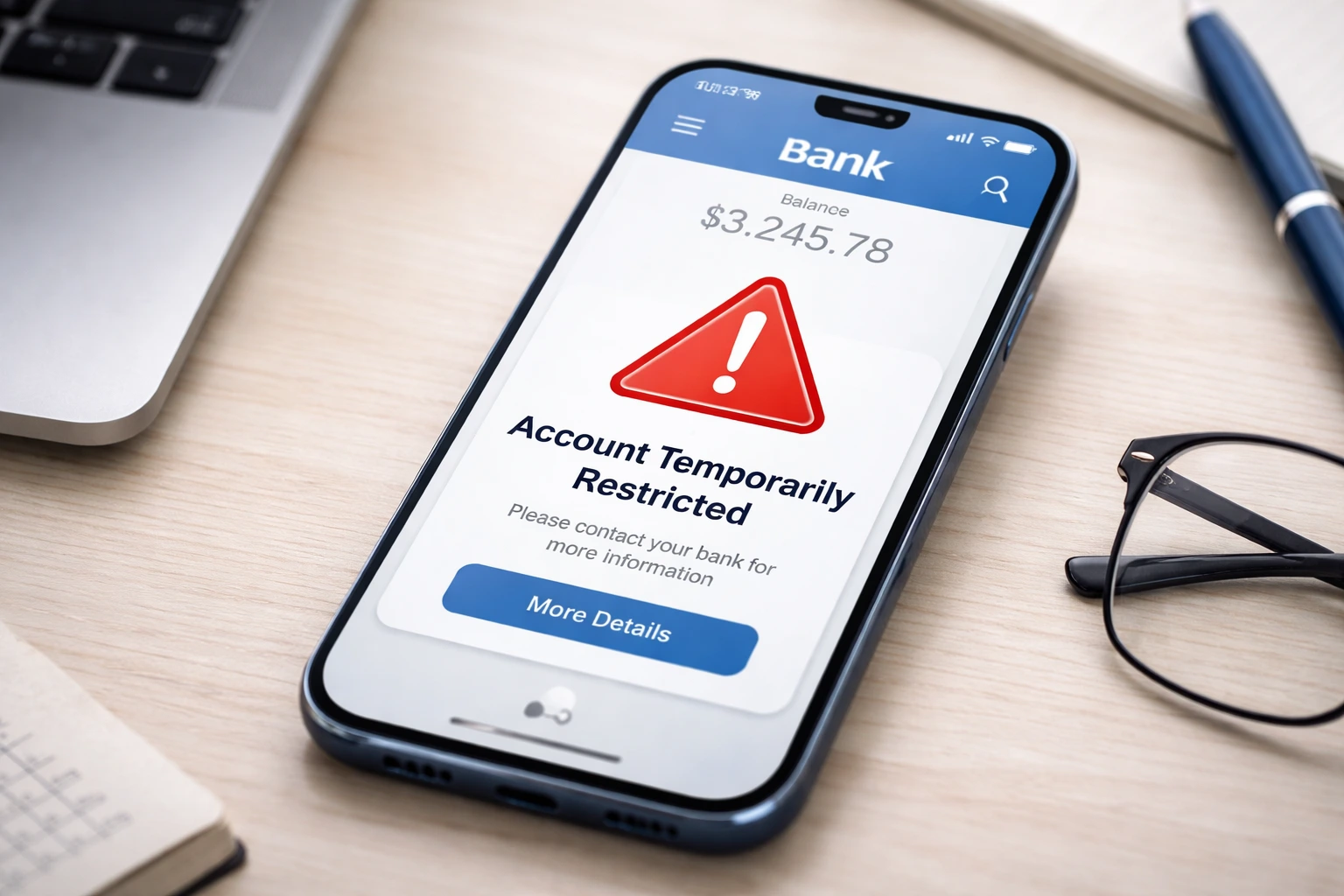
Quick answer: A bank account restriction happens when automated risk systems detect unusual activity, identity issues, or transactions that do not match your normal behavior. Most restrictions are triggered by transaction anomalies, security flags, or compliance checks, and are usually temporary while the bank reviews your account.
If your account is restricted, frozen, or under review, you are not alone. This guide explains why it happens, how banks decide to restrict accounts, and exactly what you can do to restore full access.
What Is a Bank Account Restriction?
A bank account restriction means your bank has placed limits on certain actions, such as withdrawals, transfers, or payments. This is typically done as a precaution while your account activity is reviewed.
Full explanation: restricted bank account meaning
How Banks Decide to Restrict an Account
Banks use automated monitoring systems that continuously analyze your account activity. These systems build a baseline of your normal behavior and flag anything that appears unusual or risky.
- Transaction size and frequency
- Login locations and devices
- Spending patterns
- Transfer activity and recipients
- Connections to other flagged accounts
For example, if your account typically sees small deposits and suddenly receives a large transfer, the system may flag it as unusual behavior and temporarily restrict access.
Main Reasons Bank Accounts Get Restricted
Transaction-Based Triggers
- Large or unexpected deposits
- Sudden increase in account activity
- Frequent or rapid transfers
- Sending or receiving money from unfamiliar accounts
See: why accounts get flagged after deposits
Security-Based Triggers
- Logging in from a new device or location
- Multiple failed login attempts
- Changes to account credentials
- Unusual access patterns
Related: why banking logins sometimes fail
Transfer and Payment App Activity
- Zelle transfers with new contacts
- High-frequency peer-to-peer payments
- Large incoming or outgoing transfers
Learn more: restricted after a transfer and restricted after Zelle activity
Compliance and Verification Triggers
- Missing or outdated identity verification
- KYC (Know Your Customer) reviews
- Anti-money laundering checks
- Mismatch between account activity and profile
Indirect Risk Triggers
- Receiving money from a flagged account
- Connections to suspicious transactions
- Linked accounts under investigation
Full breakdown: what triggers a bank account restriction
Common Situations That Lead to Restrictions
- Restricted after a deposit
- Restricted after a transfer
- Restricted after using Zelle
- Can a bank restrict your account?
Restricted vs Frozen vs Under Review
These terms are often confused but have different meanings:
| Status | What It Means | Access Level |
|---|---|---|
| Restricted | Limited access to certain features | Partial |
| Frozen | Account fully locked | None |
| Under Review | Account being investigated | Varies |
Compare details: restricted vs frozen account and account under review meaning
What Happens After Your Account Is Restricted
Most restrictions follow a predictable process:
- Unusual activity is detected
- The system flags the account
- A temporary restriction is applied
- Transactions may be limited or paused
- The bank reviews account activity
- You may be asked to verify your identity
- The restriction is lifted or escalated
How to Fix a Restricted Bank Account
- Contact your bank immediately
- Verify your identity if requested
- Provide documentation if needed
- Confirm recent transactions
Step-by-step guide: what to do if your account is restricted
How Long Do Bank Account Restrictions Last?
Restrictions can last anywhere from a few hours to several days. More complex situations may take longer depending on verification requirements and the nature of the flagged activity.
More details: how long restrictions typically last
Can You Still Use Your Account?
Access depends on the type of restriction. Some accounts allow deposits but block withdrawals, while others may limit all activity.
Learn more: can you receive money and can you withdraw money
How to Avoid Bank Account Restrictions
While some restrictions happen automatically and cannot always be prevented, understanding how banking security systems monitor accounts may help reduce the chances of future restrictions or fraud reviews.
Banks often build behavioral profiles based on your normal transaction activity, devices, login history, transfer patterns, and account usage. Sudden changes that appear inconsistent with your normal behavior may trigger automated fraud monitoring systems.
- Avoid sudden large or unusual transactions when possible
- Keep your personal information and identification updated
- Use consistent devices and login locations for online banking
- Be cautious with unfamiliar senders, recipients, or payment requests
- Respond quickly to bank verification or fraud alerts
- Monitor account activity regularly for suspicious transactions
- Confirm large transfers with your bank if necessary
Even legitimate activity can sometimes trigger restrictions if it statistically resembles known fraud patterns or account takeover behavior. Quick responses to verification requests and consistent account behavior may help reduce delays during reviews.
What Most People Get Wrong About Restricted Accounts
Many customers assume a restricted account automatically means fraud was confirmed or that the account will be permanently closed. In reality, most restrictions are precautionary and triggered automatically by banking security systems.
- Restrictions do not always mean fraud occurred
- Most restrictions are temporary
- Legitimate activity can still trigger fraud monitoring systems
- Banks often require verification before restoring access
- Restrictions are commonly removed after the review process is completed
Bottom Line
Most bank account restrictions are temporary security measures triggered by automated fraud monitoring systems. Understanding what caused the restriction, responding quickly to verification requests, and maintaining consistent account behavior may help restore access faster.
Frequently Asked Questions
Why was my bank account restricted?
Bank accounts are commonly restricted when banks detect unusual activity, suspicious transfers, identity concerns, fraud risks, or account behavior that requires additional verification.
Can a bank permanently restrict an account?
Most restrictions are temporary, but banks may permanently close accounts if serious fraud concerns, compliance violations, or unresolved verification problems are identified.
Can I still use my debit card if my account is restricted?
It depends on the type of restriction. Some restrictions still allow limited debit card purchases or ATM withdrawals, while others temporarily block most account activity.
What is the fastest way to remove a restriction?
The fastest way to restore access is to contact your bank directly, verify your identity, confirm recent account activity, and respond quickly to any document or verification requests.
Will a bank account restriction affect my credit score?
Bank account restrictions do not usually affect your credit score directly unless the issue eventually leads to unpaid balances, collections, or account closure involving debt.