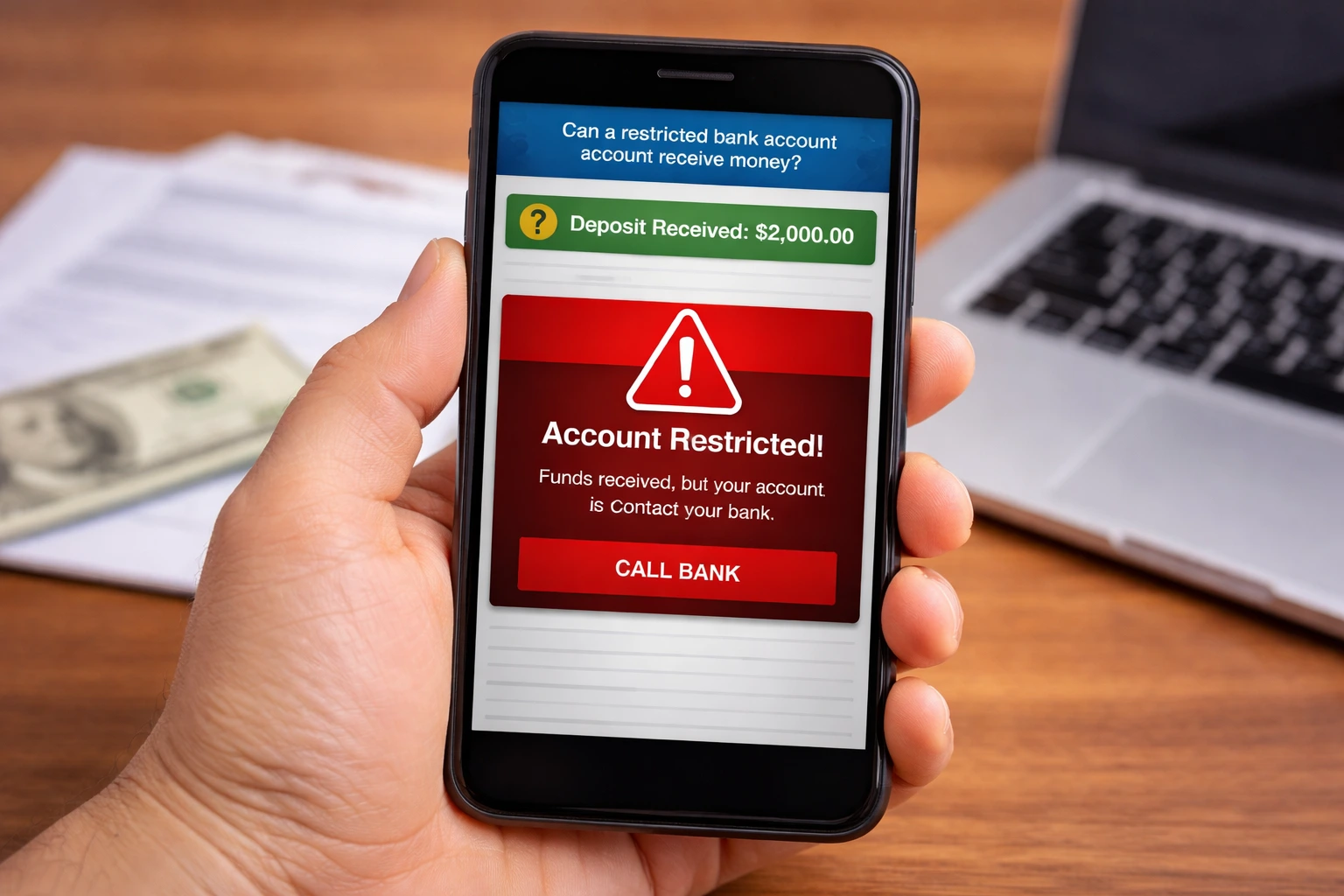
Quick answer: In most cases, yes — a restricted bank account can still receive money. Restrictions are designed primarily to control outgoing activity, not incoming deposits. However, whether you can actually access or use those incoming funds depends on the type of restriction and the specific deposit method. Some deposits post and are immediately accessible; others post but are held unavailable; and in full account freezes, incoming deposits may be blocked entirely.
Estimated reading time: 8 minutes
This guide explains exactly how different types of deposits are handled during a restriction, why banks allow incoming money while blocking outgoing activity, which deposit types are most likely to be affected, and what to do if you are expecting critical incoming funds while your account is restricted.
Why banks allow incoming deposits but block outgoing activity
The logic behind this asymmetry is straightforward: restrictions exist to prevent funds from leaving the account while the bank investigates flagged activity. An outgoing transfer moves money — potentially to a fraudulent recipient or out of reach of the bank’s review process. An incoming deposit does the opposite — it adds funds to the account where the bank can monitor them.
Blocking incoming deposits would also create significant collateral damage: payroll direct deposits would fail, employer payment systems would flag errors, and government benefit payments would be disrupted. The practical and reputational costs of blocking incoming deposits far outweigh the fraud prevention benefit, which is why most restriction types specifically target outgoing activity while leaving the incoming side open.
That said, “the account can receive deposits” and “you can access those deposits” are two different things — and the distinction matters significantly depending on your situation.
How different deposit types are handled during a restriction
Not all incoming deposits are treated the same way during a restriction. The deposit method, the source, and the restriction type all affect what happens when money arrives in your account.
Payroll direct deposits (ACH)
Payroll direct deposits from an established employer are the most reliable type of incoming deposit during a restriction. Because they originate from a known, recurring source and follow a consistent pattern, they are rarely blocked by fraud-based restrictions. In most cases, payroll deposits post normally and are accessible for withdrawal — even when outgoing transfers are blocked. The key exception is a full account freeze or a legally imposed hold, where all activity including incoming deposits may be suspended.
Government benefit payments (Social Security, SSI, disability)
Government payments — Social Security, SSI, veterans’ benefits, disability — are treated similarly to payroll deposits. They originate from a known federal source, follow a consistent schedule, and are very rarely blocked by fraud-based restrictions. Additionally, federal law provides specific protections for government benefit deposits: banks are required to protect two months of government benefit payments from garnishment in legally imposed freeze situations. If your account is frozen due to a court order or government levy, these protections may allow you to access benefit deposits that would otherwise be subject to the hold.
Incoming wire transfers
Incoming wires from known, established sources generally post to restricted accounts without issue. However, an incoming wire from a new or unfamiliar source — particularly a large one — can actually extend or escalate a restriction by adding new flagged activity to an account already under review. If you are expecting a large incoming wire while your account is restricted, notify the bank in advance through secure messaging so the incoming funds do not trigger an additional flag on top of the existing review.
Incoming Zelle and peer-to-peer payments
Incoming Zelle payments to a restricted account are treated with more scrutiny than ACH deposits. Because Zelle is instant and irreversible, and because Zelle activity is frequently connected to restriction triggers, incoming Zelle payments during an active restriction may be held pending review rather than posted immediately. In some cases, an incoming Zelle payment can extend the restriction timeline if it adds new P2P activity to an account already flagged for P2P-related concerns.
Check deposits and mobile deposits
Check deposits during a restriction are typically accepted but subject to hold periods that may be longer than normal. A Regulation CC hold on a deposited check and a fraud-based account restriction can exist simultaneously — and during a restriction, the bank may apply an extended hold on deposited checks even if the standard hold period would normally be shorter. Mobile deposits are particularly likely to face extended holds during an active restriction. The deposited funds will show in your balance but may not be available for withdrawal until both the check hold and the underlying restriction are resolved.
Deposits in a full account freeze
A full account freeze — as opposed to a partial restriction — may block incoming deposits entirely, or may accept incoming deposits but immediately subject them to the freeze. This is most common in legally imposed freeze situations (court orders, IRS levies, government agency directives) where the terms of the legal hold may specify that all funds in the account, including newly arriving deposits, are subject to the hold. If your account has been frozen rather than restricted, confirm directly with the bank whether incoming deposits are being accepted and whether they will be accessible.
Quick reference: incoming deposits by restriction type
| Restriction type | Can account receive deposits? | Are incoming deposits accessible? |
|---|---|---|
| Transfer-only restriction | Yes | Usually yes |
| Broad fraud or compliance review | Usually yes | May be held pending review |
| Identity verification hold | Yes | Usually yes once identity confirmed |
| Regulation CC deposit hold | Yes | Held funds unavailable; other funds accessible |
| Full account freeze (bank-initiated) | Sometimes | Often held; confirm with bank |
| Legally imposed freeze (court, IRS) | Sometimes — depends on legal order terms | May be immediately subject to hold |
Will a direct deposit bounce if my account is restricted?
In most cases, no. Standard fraud-based restrictions and identity verification holds do not typically cause ACH direct deposits to return. The deposit posts to the account; what is limited is your ability to move the money out.
However, there are situations where direct deposits can be affected:
- Full account freezes — in serious fraud investigations or legally imposed freezes, incoming ACH deposits may be rejected or held rather than posted
- Account closure during the restriction period — if the bank closes the account while the restriction is active, incoming deposits will be returned to the sender
- OFAC-related holds — if the account is subject to an OFAC sanctions hold, incoming transfers may be blocked at the network level before they reach the account
If you are expecting a critical direct deposit and your account is under a serious restriction or freeze, contact your bank immediately and ask specifically whether incoming ACH deposits are being accepted and posted.
Can receiving money extend or worsen a restriction?
Yes, in specific situations. This is one of the most important things to understand if your account is currently restricted.
An incoming deposit from an unfamiliar source, a large incoming wire from a new sender, or multiple incoming Zelle payments during an active restriction can all add new flagged activity to an account already under review. The bank’s monitoring system evaluates every transaction independently — an unusual incoming payment is still scored for risk even if the account is already restricted. In the worst case, an unusual incoming deposit can escalate a standard fraud review to a compliance review, which significantly extends the timeline.
If you are expecting a large or unusual incoming payment while your account is restricted, contact the bank in advance through secure messaging and explain the incoming funds. This provides context to the review team before the deposit arrives and reduces the likelihood of it being flagged as additional suspicious activity.
What to do if you are expecting critical funds while restricted
Contact the bank and ask specifically about incoming deposits
Ask the bank directly: will my payroll direct deposit post normally? Will I be able to access it when it arrives? Is there any incoming deposit type that is currently blocked on my account? Getting specific answers prevents surprises and helps you plan.
Notify the sender if there is any risk of disruption
If the bank indicates that incoming deposits may be held or that the restriction could affect incoming funds, notify the sender — your employer, a family member, a business client — so they are aware of the potential delay and can make alternative arrangements if needed.
Resolve the restriction as quickly as possible
The most reliable way to ensure incoming funds are fully accessible is to resolve the underlying restriction. Submit any requested documentation the same day the bank asks for it. For the complete guide on resolving restrictions quickly, see what to do if your bank account is restricted.
Consider a temporary alternative account for urgent incoming funds
If your restriction is expected to last several days and you have a critical incoming payment — payroll, rent, a time-sensitive transfer — opening a secondary account at another bank as a temporary measure is a legitimate option. A restriction at one bank does not prevent you from opening an account elsewhere (unless the restriction has led to account closure with a negative finding reported to ChexSystems). If you go this route, update your direct deposit information with your employer as quickly as possible, as payroll changes typically take one to two pay cycles to take effect.
Frequently Asked Questions
Can a restricted bank account receive direct deposit?
In most cases, yes. Payroll direct deposits and government benefit payments are the deposit types most reliably received during a restriction. They originate from known, consistent sources and are rarely blocked by standard fraud-based restrictions. In full account freezes or legally imposed holds, direct deposits may be affected — confirm with your bank if you are in one of those situations.
Can money be sent to a restricted bank account?
Yes for most deposit types under most restriction scenarios. Standard fraud reviews and identity verification holds do not typically block incoming ACH, wire, or check deposits. Full account freezes and legally imposed holds may restrict incoming deposits depending on the severity and terms of the hold. Zelle and peer-to-peer incoming payments are more likely to face holds during an active restriction than ACH deposits.
Can I access money that arrives in my restricted account?
Not necessarily immediately. A deposit posting to your account during a restriction and those funds being available for withdrawal are two different things. In many restriction scenarios, incoming funds post to the account but cannot be withdrawn or transferred until the restriction is resolved. Check your available balance vs your total balance — if total balance includes the new deposit but available balance does not, the funds are held.
Will a Zelle payment still arrive if my account is restricted?
It depends on the restriction type. Standard restrictions do not necessarily block incoming Zelle payments, but incoming Zelle during an active restriction may be held pending review rather than posted immediately — particularly if the account was restricted due to Zelle-related activity in the first place. The bank may also flag the incoming Zelle as additional unusual activity and add it to the existing review. If you are expecting an important Zelle payment, consider asking the sender to use a standard bank transfer instead, which carries a lower risk score during an active review.
Can receiving money make my restriction worse or last longer?
Yes, in specific situations. An incoming deposit from a new or unfamiliar source, a large wire from a sender not previously seen on the account, or multiple incoming Zelle payments during an active restriction can all add flagged activity to an account already under review. The monitoring system evaluates incoming transactions independently — unusual incoming activity can escalate a standard fraud review to a compliance review, significantly extending the timeline. Notify the bank in advance of any unusual incoming funds while the restriction is active.
What if my direct deposit bounces because of the restriction?
Contact your bank immediately and ask why the deposit was returned. Standard fraud restrictions typically do not cause direct deposit returns — if a deposit bounced, the restriction may be more serious than a standard review. Ask the bank specifically what type of restriction or freeze is active and whether incoming ACH deposits are currently accepted. If the bank confirms deposits are blocked, notify your employer immediately so they can issue payment by an alternative method. You can also file a complaint with the Consumer Financial Protection Bureau complaint portal if the bank is not providing clear answers.
