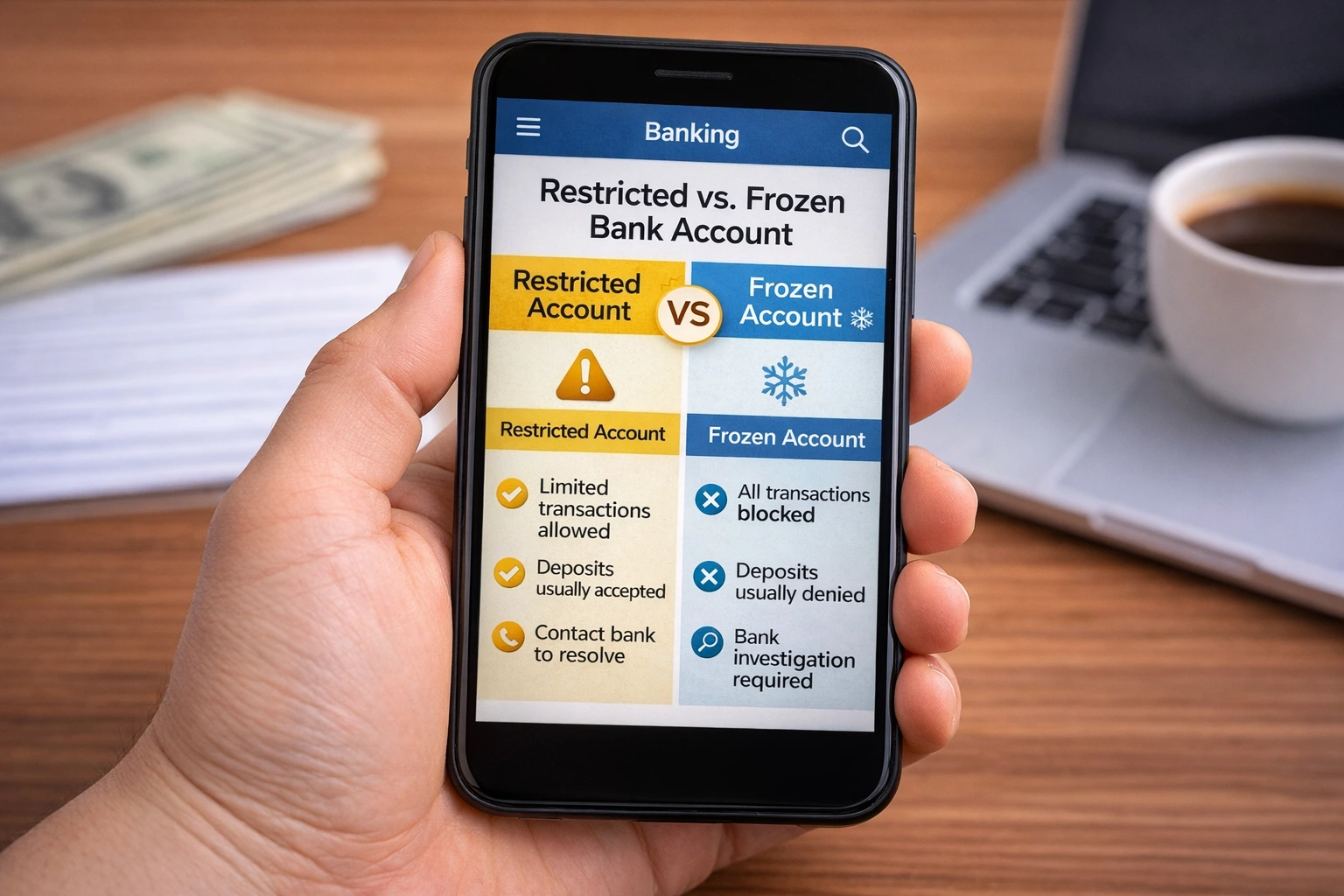
Quick answer: A restricted bank account means some account functions have been temporarily suspended while the bank conducts a review — other functions often still work. A frozen bank account means most or all account activity has been suspended, including both outgoing and sometimes incoming transactions. Freezes are more severe than restrictions, are associated with more serious triggers, and typically take longer to resolve. Knowing which one you have determines what you can still do and what steps to take.
Estimated reading time: 9 minutes
Restricted vs frozen: the key differences at a glance
| Feature | Restricted account | Frozen account |
|---|---|---|
| Severity | Moderate — partial limitation | High — full suspension |
| Outgoing transfers | Often blocked | Blocked |
| Debit card purchases | Sometimes still works | Usually blocked |
| ATM withdrawals | Often still works | Usually blocked |
| Incoming deposits | Usually still works | Sometimes blocked |
| Online banking access | Usually still works | May be limited |
| Common triggers | Unusual activity, identity issues, fraud flag | Serious fraud, account takeover, legal hold |
| Who initiates it | Bank’s automated monitoring system | Bank’s fraud/compliance team or legal process |
| Typical resolution time | Hours to 5 business days | Days to weeks; legal freezes indefinite |
| Resolution path | Verify identity or explain flagged activity | Bank review plus possible legal process |
What a restricted bank account actually means
A restriction means some but not all account functions have been temporarily suspended. The bank has flagged activity that requires review, but it has not determined the situation warrants stopping all account access — only the specific functions most associated with the risk it detected.
The most common pattern for a restricted account: outgoing transfers are blocked, but you can still make debit card purchases, receive deposits, view your balance, and in many cases make ATM withdrawals. The restriction is targeted — it is designed to prevent money from leaving the account while a human reviewer evaluates the flagged activity.
Restrictions are almost always applied automatically by the bank’s fraud monitoring system before any human reviews the account. They are the system’s way of pressing pause while the review process begins. Most restrictions are temporary and are lifted once the bank completes its review and confirms the flagged activity is legitimate.
For the complete explanation of what a restriction involves and what you can still do, see what a restricted bank account means.
What a frozen bank account actually means
A freeze is a more complete suspension of account activity. When an account is frozen, most or all functions are blocked — typically including outgoing transfers, ATM withdrawals, debit card purchases, and in some cases even incoming deposits. A freeze communicates that the bank has determined the situation warrants stopping all account movement, not just outgoing transactions.
Freezes are associated with more serious triggers than standard restrictions. The most common causes include suspected account takeover (where someone other than the legitimate account holder appears to have gained access), significant fraud indicators involving large-scale money movement, AML compliance investigations, or legally imposed holds from court orders, IRS levies, or government agency directives.
The critical distinction between bank-initiated freezes and legally imposed freezes is that the bank can lift a bank-initiated freeze once its review is complete — but it cannot lift a legally imposed freeze on its own. Legal freezes require the underlying legal matter to be resolved before the bank can take any action.
For the complete explanation of when and why freezes occur, see why bank accounts get frozen.
How to tell which one you have right now
The fastest way to identify whether you have a restriction or a freeze is to test what still works on your account:
Signs you likely have a restriction
- Your debit card still works for purchases but transfers are blocked
- You can still log into online banking and view your account normally
- Incoming deposits are posting to your account
- ATM withdrawals are working even though transfers are not
- The bank’s message says “restricted,” “limited,” or “under review”
Signs you likely have a freeze
- All outgoing activity is blocked — transfers, ATM, card purchases, all failing
- Incoming deposits are also blocked or not posting
- Online banking access is limited or shows an account status message
- You received a notification about a legal hold, court order, or government levy
- The bank’s message uses the word “frozen,” “blocked,” or “all activity suspended”
If you are still unsure, call the bank using the number on the back of your debit card and ask specifically: “Is my account restricted or frozen, and what specific functions are currently blocked?”
What you can do with each — side by side
| Account action | Restricted account | Frozen account |
|---|---|---|
| View balance and history | Yes | Usually yes |
| Receive payroll direct deposit | Usually yes | Sometimes — depends on freeze type |
| Receive incoming wire or ACH | Usually yes | Sometimes blocked |
| Make debit card purchases | Sometimes yes | Usually blocked |
| ATM cash withdrawal | Often yes | Usually blocked |
| In-branch cash withdrawal | Often yes with ID | Usually blocked |
| Send ACH or bank transfer | Usually blocked | Blocked |
| Send Zelle or P2P payment | Usually blocked | Blocked |
| Send wire transfer | Usually blocked | Blocked |
| Use secure messaging | Yes | Usually yes |
What triggers each — and why the trigger matters
Common restriction triggers
Restrictions are triggered by the bank’s automated monitoring system when account activity deviates from your established baseline or matches a known risk pattern. Common triggers include a transfer significantly larger than your normal history, a Zelle payment to a new recipient, a large or unusual deposit, a login from a new device or location, or an identity verification issue. These are moderate-risk signals — enough to warrant a review and a pause on outgoing activity, but not enough to trigger a complete account shutdown.
Common freeze triggers
Freezes are triggered by higher-risk signals: suspected account takeover (where the login patterns, device, and transaction sequence match account takeover fraud), significant AML or structuring concerns, serious fraud indicators involving large sums, or external legal action. Bank-initiated freezes represent the bank’s assessment that the situation is serious enough to stop all account movement. Legally imposed freezes represent an external legal requirement that the bank has no discretion to refuse.
How long each typically lasts
| Situation | Typical timeline |
|---|---|
| Identity verification restriction | Hours to 1 business day |
| Standard fraud review restriction | 3–5 business days |
| AML or compliance restriction | 5–10+ business days |
| Bank-initiated freeze (fraud or security) | 3–10 business days |
| Bank-initiated freeze (AML or compliance) | 5–15+ business days |
| Legally imposed freeze (court order, IRS levy) | Until the legal matter is resolved — no defined maximum |
For both restrictions and bank-initiated freezes, responding to the bank’s documentation requests the same day they are made is the most effective way to stay at the shorter end of any timeline. For the complete breakdown, see how long bank account restrictions last.
What to do for each — the resolution paths differ
If your account is restricted
Check your bank’s secure messaging inbox first — the bank has often already sent a message explaining what triggered the restriction and what is needed. Then contact the bank through an official channel, ask specifically what type of restriction is active and what documentation is required, and submit everything the same day. Most restrictions are resolved within a few business days when the account holder responds promptly. For the complete guide, see what to do if your bank account is restricted.
If your account is frozen — bank-initiated
Contact the bank immediately and ask specifically what type of freeze is active, what triggered it, what department is handling it (fraud, security, or compliance), and what documentation is needed. Submit everything requested the same day. Follow up in writing through secure messaging if the freeze extends past the bank’s stated timeline. If the freeze extends past 10 business days without resolution, file a complaint with the Consumer Financial Protection Bureau complaint portal — banks are required to respond within 15 days.
If your account is frozen — legally imposed
Contact the bank to confirm the source of the freeze — which court, agency, or legal process initiated it. The bank cannot lift this type of freeze on its own. You need to address the underlying legal matter directly. For court orders and garnishments, consult a licensed attorney — many states have exemptions that protect certain funds (Social Security, disability, veterans’ benefits, and sometimes a minimum balance) from garnishment, but you typically must file a claim of exemption with the court within a specific window to access them. For IRS levies, contacting the IRS directly or working with a tax professional to establish a payment plan is the most direct path to having the levy released.
Frequently Asked Questions
What is the difference between a restricted and frozen bank account?
A restricted account has some functions temporarily suspended while others still work — most commonly outgoing transfers are blocked but ATM access, debit card purchases, and incoming deposits continue. A frozen account has most or all activity suspended, including outgoing transfers, ATM access, card purchases, and sometimes incoming deposits. Restrictions are associated with moderate fraud or compliance signals; freezes are associated with more serious fraud, account takeover, or legal holds.
Which is worse — restricted or frozen?
A freeze is more severe. A restriction is a targeted pause on specific functions; a freeze is a broader suspension of account activity. Freezes are associated with more serious triggers, are handled by more senior bank teams, and take longer to resolve. Legally imposed freezes — the most severe type — have no defined resolution timeline and can last indefinitely until the underlying legal matter is resolved.
Can a restricted account become a frozen account?
Yes. If a bank’s review of a restricted account uncovers activity it cannot explain or clear — or if the initial flag was connected to a more serious fraud or compliance concern — it may escalate the restriction to a full freeze. This is one of the reasons it is important to respond promptly to bank documentation requests during a restriction: delays can extend the review period and increase the risk of escalation.
Can I withdraw money from a restricted account?
Often yes, depending on the restriction type. Transfer-only restrictions — the most common type — typically do not block ATM withdrawals or debit card purchases. Broader fraud or compliance restrictions may block all outgoing activity including withdrawals. Test an ATM withdrawal to determine what is blocked on your account. See can you withdraw from a restricted bank account for the full breakdown by restriction type.
Can I withdraw money from a frozen account?
Generally no. Full account freezes block most or all outgoing activity including ATM withdrawals and debit card purchases. In some bank-initiated freezes, in-branch withdrawal with a government-issued photo ID may still be possible — it is worth asking the bank specifically. For legally imposed freezes, certain funds may be exempt from the hold under federal or state law, and an attorney can help you file a claim of exemption to access those funds.
How long does a frozen account last compared to a restricted account?
Restrictions typically resolve within a few hours to five business days for standard fraud or identity reviews, and up to ten business days for compliance reviews. Bank-initiated freezes typically take three to fifteen business days depending on severity. Legally imposed freezes have no defined maximum timeline — they last until the underlying legal matter is resolved, which can take weeks, months, or longer depending on the legal process involved.
Does a restricted or frozen account affect my credit score?
No. Neither restrictions nor freezes are reported to the major credit bureaus and neither affects your credit score. If a restriction or freeze leads to account closure with a negative finding, that closure may be reported to ChexSystems or Early Warning Services — a separate screening system banks use when evaluating new account applications — which can affect your ability to open accounts at other institutions, but this is entirely separate from consumer credit reporting.
