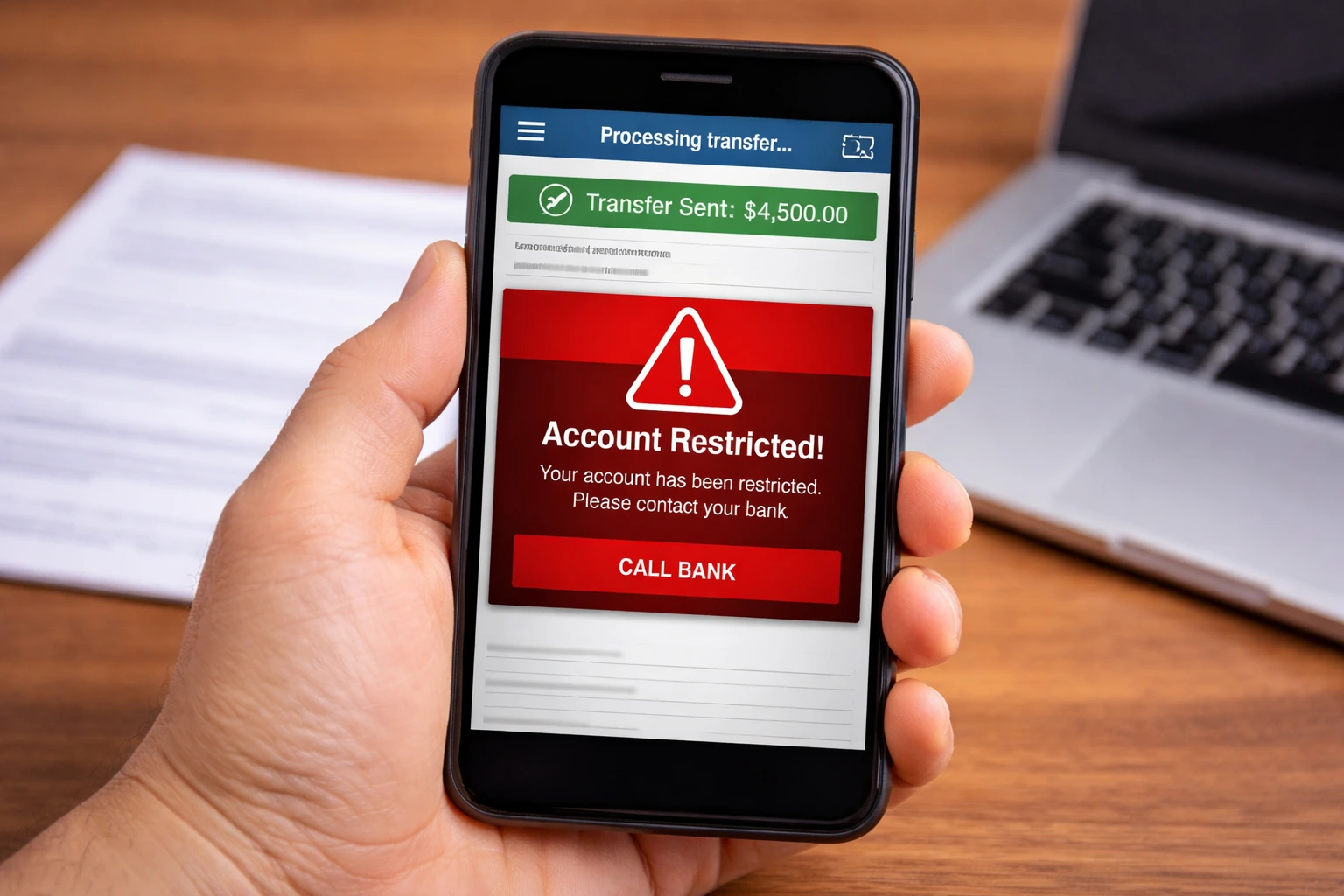
If your bank account was restricted after a transfer, it usually means the transaction triggered a security or fraud review. This can happen when a transfer is larger than your normal activity, sent to a new recipient, involves rapid movement of funds, or does not match your typical account behavior.
Quick answer: Banks restrict accounts after transfers when they need to verify the transaction, confirm account activity, or review potential fraud risk. Most transfer-related restrictions are temporary and are removed once the bank confirms the activity is legitimate.
If this happened suddenly, it does not usually mean your account is permanently restricted or that your money is gone. In most cases, the bank is temporarily limiting access while it reviews the transaction.
This type of restriction is common. Many transfer-related restrictions are triggered automatically by banking security systems that monitor transactions, devices, and account behavior in real time—often before a human reviewer ever examines the account.
What Happens After a Transfer Triggers a Restriction
Most banks use automated fraud monitoring systems that analyze transfers in real time and compare them to your normal account behavior, transaction history, devices, and activity patterns. When something stands out, the system may temporarily restrict your account while it reviews the transaction.
This is how the process typically works:
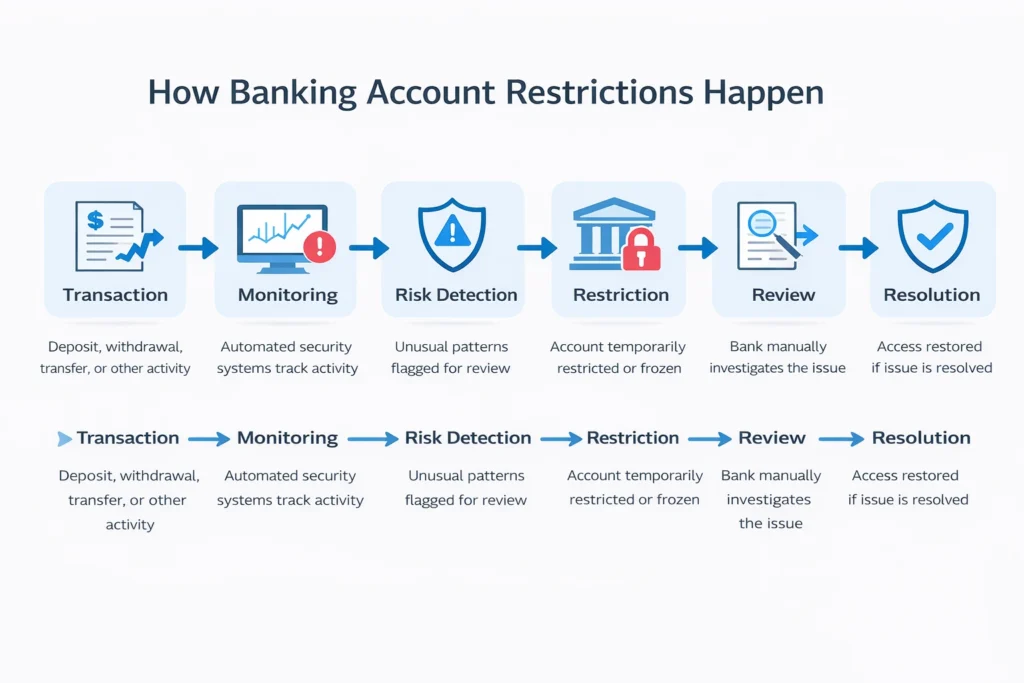
In most cases, the process follows a simple pattern: the transfer is flagged, a temporary restriction is applied, and the bank reviews the activity before restoring access once the transaction is verified.
In many situations, this review begins automatically before a human reviewer is involved. This means even legitimate transfers can trigger temporary restrictions if they fall outside your normal account activity.
How Banks Detect Suspicious Transfers
Modern banks use automated fraud monitoring systems that analyze transfers in real time and compare them to your normal account behavior, transaction history, devices, locations, and activity patterns.
If a transfer appears unusual—such as a larger-than-normal amount, a new or unrecognized recipient, rapid movement of funds, or activity from a new device or location—the system may flag the transaction and temporarily restrict the account.
These systems are designed to detect potential fraud, account takeovers, and suspicious transfer behavior before money can be moved or withdrawn.
In many cases, these restrictions are triggered automatically before a human reviewer ever examines the account. This means legitimate transfers can sometimes be flagged simply because they fall outside your normal activity pattern.
Why Your Bank Account Was Restricted After a Transfer
Transfers are one of the most common triggers for account restrictions because they involve moving money between accounts. Banks monitor these closely for unusual patterns.
The transfer amount was unusual
- Large transfers compared to your normal activity
- High-value payments that appear unexpected
- Multiple transfers in a short period
The recipient or sender was new
Sending money to a new account or receiving funds from an unfamiliar source can trigger a review.
The transfer triggered fraud detection systems
- Rapid movement of funds between accounts
- Transferring money immediately after a deposit
- Activity that differs from your normal behavior
For a broader explanation, see why bank accounts get restricted.
The transfer required verification
Some transfers require additional checks, especially for large amounts or cross-account activity. The bank may temporarily restrict your account until the transaction is confirmed.
This is often part of a review process. Learn more in what it means when your account is under review.
What This Type of Restriction Means
A restriction after a transfer usually means certain account features are temporarily limited while the bank reviews the transaction.
- Outgoing transfers may be blocked
- Incoming transfers may be delayed
- Debit card transactions may be declined
- Your account may be under review
If you need a full explanation, see what a restricted bank account means.
What To Do If This Happens
If your account is restricted after a transfer, taking the right steps can help resolve the issue faster.
- Contact your bank using official channels
- Confirm what triggered the restriction
- Verify the transfer details if requested
- Avoid repeated transfer attempts
- Follow all instructions carefully
For a full guide, see what to do if your bank account is restricted.
How Long Restrictions Last After a Transfer
- 1 to 3 business days for standard reviews
- 3 to 7 days for more detailed verification
- Longer in complex situations
See how long bank account restrictions last for more details.
Can You Still Access Your Money?
Access depends on the type of restriction. Some accounts allow limited withdrawals or deposits, while others temporarily block most activity.
See whether you can withdraw from a restricted account.
What Most People Get Wrong About Transfer Restrictions
Many people assume that a restriction after a transfer means the bank has confirmed fraud or that the money is permanently locked. In reality, most transfer-related restrictions are temporary and are part of a verification process.
Even legitimate transfers can trigger restrictions if they appear unusual compared to your normal activity. In most cases, access is restored once the bank confirms the transaction is valid.
How to Prevent This in the Future
- Avoid sudden large transfers outside normal activity
- Verify recipients before sending money
- Notify your bank before high-value transfers
- Keep your account information updated
Bottom Line
If your bank account was restricted after a transfer, the bank is usually verifying the transaction or reviewing potential risk. Most restrictions are temporary and are removed once the activity is confirmed as legitimate.
Related Banking Restriction Guides
- What a restricted bank account actually means
- Why banks temporarily restrict accounts
- Whether restricted accounts can still receive money
- How long restrictions usually last
Common Questions
Why was my bank account restricted after a transfer?
Your bank may restrict your account after a transfer if the transaction appears unusual, involves a new recipient, is larger than normal, or triggers fraud monitoring systems.
Can a bank transfer cause an account restriction?
Yes. Large transfers, rapid money movement, new recipients, or transfers that do not match your normal account activity can trigger a temporary restriction or review.
How long does a transfer-related restriction last?
Many transfer-related restrictions are resolved within 1 to 3 business days, but more detailed fraud, identity, or compliance reviews may take longer.
Will the transfer still go through if my account is restricted?
Sometimes. The transfer may complete, be delayed, held for review, reversed, or blocked depending on the bank’s review process and the reason for the restriction.
Can I still receive money if my account was restricted after a transfer?
In many cases, restricted accounts can still receive deposits or incoming transfers, but access to those funds may be limited until the restriction is resolved.
